Showing posts with label 19th century short sleeved dresses. Show all posts

Wednesday, August 22, 2012

1840s green fan front dress (construction details)

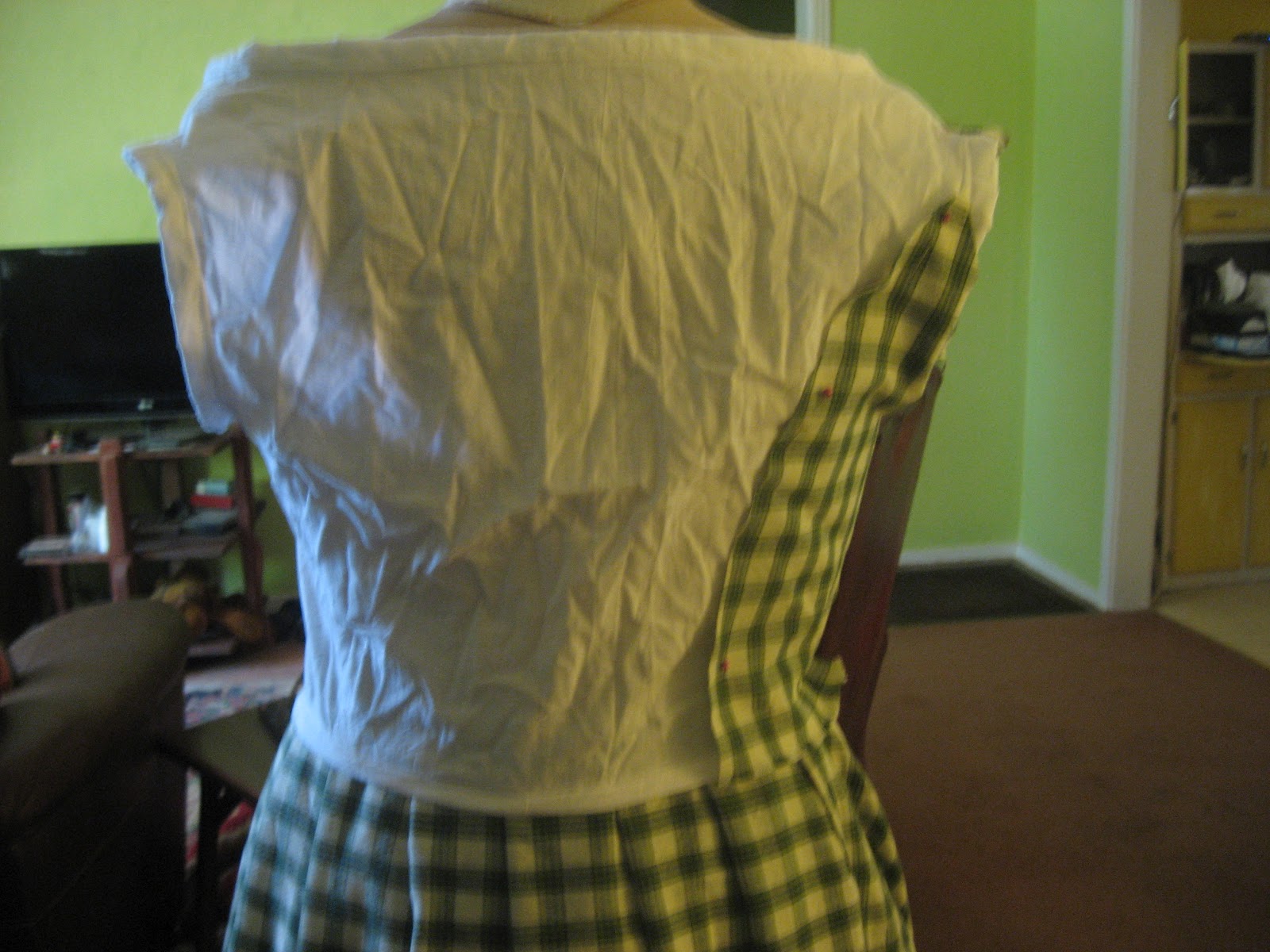
I went ahead and did it.  I made a short(er) sleeved dress for work.  After going home one day with heat exhaustion due to EXTREME weather conditions and very non-summery clothing, I said enough was enough.  I still maintain, despite a lack of concrete evidence at the moment, that women in Columbia did not necessarily adhere to the standards of European society  or the upper class women of the East Coast.

So I got to thinking, what can I make this outfit out of?  I went to JoAnn's and found a very nice green plaid homespun.  It wasn't what I went in for, but it worked well enough.  I wanted a semi-sheer print, but I guess that will have to wait.  Upon getting home, I went to work on it.

This first dress was probably the primary inspiration for my new dress:

Woman’s dress made in America between 1840-45.  Constructed in cotton.  Gift of The New York Historical Society, 1979, Accession Number: 1979.346.35.  From the Metropolitan Museum of Art, http://www.metmuseum.org.

Woman's Dress made in the United States c.1840, attributed to an American maker.  Constructed in Gold China silk crepe with silk embroidery in satin stitch.  Gift of Howard H. Lewis, John F. Lewis III, and Mrs. Anne L. Stoudt, 1979.  From the Philadelphia Museum of Art, http://www.philamuseum.org.

Dress showing the lining and center front closures.  Uploaded by Anette Bethke, http://pinterest.com/netnet81/.

D01-87.    AWESOME EYES!”  c.1851, American (possibly Ohio).  From Dennis A. Waters Fine Daguereotypes, http://finedags.com. 
Afternoon dress.  Constructed in cotton c.1843 in America.  Purchased from The German Fur Federation Gift, 1981.  Accession number 1981.14.5.  From the Metropolitan Museum of Art, http://www.metmuseum.org.
Armed with these images, I set to work on drafting up some patterns from Patterns of Fashion for the 1852 day dress (again).  I altered the actual bodice a bit in the neckline and the sleeves on mine are much more practical for what I believe a working woman could have worn.

The lining and a trial version of the skirt

back view of the lining

I love how scooped the lining is

Trial of the pleats

Here's what we're aiming for, more or less

Close up and flashed

I raised the hemline of the corded petticoat I made last year after reading an article on skirt supports at historicalsewing.com.  It works WONDERFULLY now

Just about done, sorry for the blurriness
 
does it make your eyes hurt yet

Major thanks also to Katherine at The Fashionable Past for her article: An Easy, Authentic Eighteenth Century Petticoat that I used for making the skirt.

Since Columbia SHP will be having an 1861 themed back to school night on Sep. 15th, I'm planning a nice little Swiss waist to wear with a cute white shirt I made (also with elbow length sleeves ;) )

Final photos to follow soon...

Tuesday, June 19, 2012

A Tribute to the Pink and Green

I have wanted this dress ever since I first stumbled across the fashion plate on 15 Aug 2011.  I printed it, which is amazing for me to do.  It's just too absolutely fabulously tacky.  I actually like both outfits in the print, but the pink and green one is my favorite.
Fashion plate found at The Costumer's Manifesto
One of the new outfits I'm making will be inspired by this dress.  I do not have the time or patience right now to piece together the squares necessary to make such an extraordinary dress.  I will though.  I just have to clear a path in my mess or a garage to get to the pale green satin I have stashed away and hope there's enough to do what I want.  I'll also need a pretty pale pink too.  Instead, I will be doing something similar.  I will still be making a basque, but of solid pink.  It will go with a green skirt.
Portrait of M. Obleuhova by Vasiliy Pukirev, 1855
 The basque jacket in this portrait will be the inspiration for the pink one I'm making to go with the green skirt.

The second outfit is partially inspired by this painting by Lilly Martin Spencer.
Peeling Onions, ca. 1852. Lilly Martin Spencer.
 I want a dress that feels working class, but is made of pretty fabric.  It will be more of a mid 1840s style as I believe this would have been brought to Columbia as a woman moved across the country.  By 1852, it would be well worn and quite appropriate for a woman to work in.  I'll be basing the dress off of the following;
Afternoon dress ca. 1845 via The Costume Institute of the Metropolitan Museum of Art
Woman's Dress, c. 1840 from the Philadelphia Museum of Art.  Made in the USA

The sleeves of this new dress will be cropped off about where the over-sleeve stops on this one.  I fully believe short sleeves could have been worn, besides there is no point in having a bunch of excess fabric pushed up on my arms since I intend to roll up my sleeves anyway.  I'll be using a rather "loud" paisley print fabric on a white background.  This dress helped in easing my fears about it looking too busy.
Woman’s Two-piece Dress, circa 1855 from the LACMA

More 19th century dress research

I have had several new thoughts regarding my new research projects.  I am by no means an expert on 19th century clothing, I'm learning as I go.  I do, however, feel it is important to share this quote before I start writing again:
The V&A's Victorian dress collection represents the fashions worn by the wealthy in the 19th century, and reflects their lives and aspirations. ...The degree of workmanship involved in making these clothes meant that they were expensive to make -they were high fashion comparable to today's haute couture. ... The middle classes generally would not wear such high value items such as these. However, the style of these clothes would have spread further than the small social group for whom they were made, much the same as adapted catwalk fashions can be found in high street retailers today. The middle classes could afford to have high fashion copied by local dressmakers and tailors, or made their own new clothes. ... The poor would rely on the huge second-hand clothes trade prevalent during the period, spending hours altering old clothes for themselves and their families to make them fit or to make them more fashionable. Clothes could be dyed and the good parts of a garment made into children's clothes or accessories, and areas of wear could be patched. There was even a market for ragged clothes that had been through several owners - these were still worn by the destitute. -- "Victorian dress at the V&A" from The Victoria and Albert Museum
There really was no good place to crop that quote off really since it is so very relevant, so sorry for the length.  While it is in reference to the items in the V&A's collection of 19th century clothing and more specifically to England, the sentiment of the quote is still applicable to the United States and specifically to California.  US fashions were influenced by Europe.  The select few that could afford to have the "haute couture" versions of dresses in fashion plates were few and far between.  Those of a middle class background could and did have similar versions of these dresses made.  Those that were poor were left to inherit the secondhand, slightly out of date fashions.

As women (and men too) moved across the US, further away from centralized institutions that controlled social structure, the rules became more relaxed.  The smaller number of women in California presented them with the opportunity to become financially successful themselves.  Several women were able to make a rather impressive living doing the same things women did everyday across the country.  It is likely that the average working woman's wardrobe did consist of secondhand clothes and out of date fashions, but it is just as likely that the new-found financial success also provided a means to either make or have made clothing that was more in line with the popular East coast versions.
Peeling Onions, ca. 1852. Lilly Martin Spencer.
I think this is perhaps more what should be the common attire in Columbia.  It's an actual working dress, not a prairie dress.  Women didn't wear their best clothes to work in.  Not to mention the fact that the sleeves are either short or pushed up to be short.  Seems infinitely more practical to me.
Image found on Pinterest, credited as from finedags.com
I thought this was super interesting.  I've been told (again no concrete proof on my part) that women did not wear much jewelery if they were unmarried.  This woman is wearing quite a bit, leading me to believe she is married and has a pretty decent financial situation.  I thought it was also interesting that this is a short sleeved, sheer dress not unlike these two below.
from The Met

from The Met
Granted they are from different time periods, the concept is the same.  A summer dress with short sleeves for a WOMAN, not a girl or teenager.

Now apply that quote from the V&A to this situation.  The high class version that mimics the fashion plate could be seen as the period dag of the mid-late 1850s woman with jewelery.  The surviving example available in museums are the two dresses in a late 1840s style.  These dresses probably belonged to women of at least a middle class background.  It still seems probably to me that a dress such as this could have been worn by a working class woman, perhaps not in such fine, easy to soil fabric though.

Friday, June 15, 2012

Research: Short sleeved dresses

Having spent one summer and gearing up for a second working in Columbia in a long sleeved dress, I find it very difficult to believe that women of the 1850s (and the rest of the 19th century) did not have a short sleeved summertime option for dresses.  I know the popular thought around me says that "oh no, they wore sleeves all the time, and bonnets, and doilies on their heads at all times."  I don't believe it, but I digress.

In the interest of saving my dresses from sweat stains (gasp!) and myself from having a heat stroke while I restock wine, beer, and move deliveries around, I have begun a little research project.  I hypothesize that there were short sleeved dresses for women--and not just young ones or ball gowns.  I'm talking about daytime attire.

I have not spent too much time researching (the wedding and life ate up a bunch of my time you know), but I did manage to find a large collection of dresses at the Met that are American made, cotton, from the mid 19th century, not classified as ball gowns, and SHORT SLEEVED.

My criteria to be on this research list:
1. Must be from between 1835-1855.
2. Must not be a dress for evening of dinner or a ball gown
3. Must be for an adult woman
4. Must be American
5. Must be cotton
(note all links to the Met are to the dress's page)
Exhibit 1: Late 1840s Mourning Dress from The Metropolitan Museum of  Art
 This dress, like the others could have had detachable sleeves to make it long sleeved, but they have no survived.  For the sake of argument, I'm going to assume they were not worn with this dress.  The first thing I noticed is that it's a mourning dress, to be worn at a time of great sadness.  If exposing the skin of the arms was not done in polite society, why would it have been done then?  Sure, you wouldn't be out socializing if you're in mourning, but I would assume out of respect you wouldn't have worn clothing that was not generally considered appropriate.  Plus, the neckline is very conservative, there is not much trim on the dress.  It's a simple black and white cotton dress with pleating.

Exhibit 2: c. 1847 Dress from The Metropolitan Museum of Art
 This dress appears to be a day dress to me.  The neckline is not low enough to be an evening or ball gown.  There is no embellishment.  It's a simple cotton dress.  Seems perfectly appropriate to wear in hot weather to me.

Exhibit 3: 1849 Wedding Dress from The Metropolitan Museum of Art
 While this is not a "day dress," but for a fancy occasion, I included it for a reason.  It's simple.  The only fancy decoration is the silk on it.  The dress itself is cotton and modest.  It's got the same almost boat-neck neckline as the other day dresses, the same pleating, and the same short sleeves.  Only difference is the specific event it was made for and the modest silk trim.

Exhibit 4: 1841-1844 Dress from The Metropolitan Museum of Art
This is the perfect example of summer.  It's a simple white cotton dress with short sleeves.  No frills, bells, or whistles.  Its screams day wear to me.

From what I can tell, it appears short sleeves are okay to wear.  Sure it's possible these dresses were worn with detachable sleeves, but it's also entirely possible they were not.  If a woman owned them (or something similar) when they were new and brought them across the country sometime around 1850, they would be "old clothes."  These wouldn't necessarily be the dresses you cherished and wore to fancy events.  These would be what you wore around your home or at work, when you didn't need to worry about damaging them.  They are the 19th century equivalent of those faded, torn, and worn out jeans that you wear on weekends or when you want to be comfortable.  Or that thread bare T-shirt that you wear to clean your house.  You don't wear those to make an impression on people, you wear them because they are comfortable.  I doubt very much that a woman living in Columbia, CA c. 1850 that had to work to support herself or even a family would have thought twice about wearing comfortable old dresses without all the fine accessories they might once have had.

Friday, May 20, 2011

History FAIL

I made one today and I felt horrible.  Since I do not have appropriate footwear for 1852 I've been wearing a pair of little ballet flats (hey better than tennis shoes, right?).  Well today I was in such a rush to get going at work that I didn't bother to roll up my pants, put on a petticoat, and I forgot my shoes.  I felt bad none-the-less though.  Mostly because last weekend when I was sitting on a rock reading I was snickering into my book about a few women that only half-assed their outfits. Fortunately I'm getting enough hours now that I can actually continue on with making an appropriate outfit for work.

Which brings me to the real point of writing this.  Has anyone ever seen photos of or heard of a work dress for 1850-52 that had short sleeves?  I'm trying to be as accurate as possible and still maintain the ease of being able to do my job.